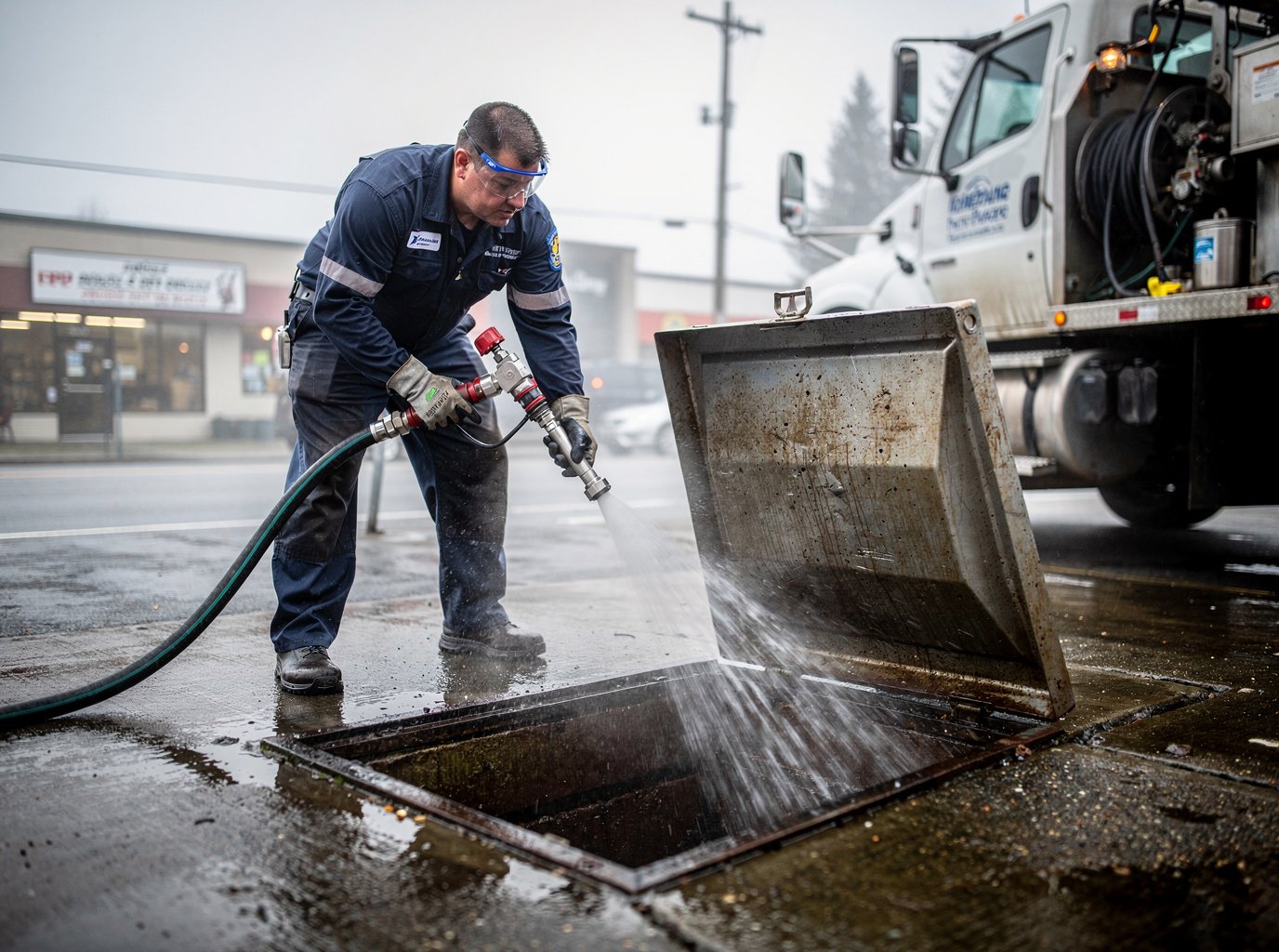
Tacoma's mild marine climate brings heavy winter rains that increase water volume through grease traps, but the real problem surfaces in buildings constructed before the 1970s in the North End, Hilltop, and Downtown Tacoma. Cast iron and early PVC lines in these neighborhoods collect layers of fats, oils, and grease that standard pumping misses, especially when restaurants near the Tacoma Dome or Chihuly Bridge of Glass run high-volume fryers. Hydro jetting at 4,000–5,000 psi breaks up those deposits without chemicals that could violate Pierce County wastewater rules.
Many commercial kitchens in the Stadium District and Proctor District still use 3- or 4-inch laterals that were never sized for today's cooking loads. When grease solidifies during cooler summer nights, it creates upstream backups that reach the trap within days. A proper jetting pass starts at the cleanout, works upstream to the trap, then flushes the downstream run to the city main so solids do not redeposit in the wet season.
Edge cases appear in University Place and Lakewood restaurants where clay or Orangeburg pipe still exists. Jetting pressure must be lowered and a camera run first to avoid fracturing brittle sections. Federal Way locations with higher water tables also see more root intrusion mixed with grease, requiring a two-step process of cutting roots before the final jetting pass.
Homeowners and property managers often schedule this work after a health department inspection flags a trap that is more than 25 percent full. Skipping the downstream flush leaves material that re-enters the trap during the next rain event, which is why we always verify flow to the main before leaving the site.
Technician insight
In Tacoma the thing that catches most people out with grease trap hydro jetting is the wet winter rain load pushing extra water through lines that already hold years of FOG in pre-1970 cast iron under North End and Hilltop restaurants. They think a trap pump-out is enough until the next storm backs it up again.
Stadium District restaurant backup
A busy kitchen near the Tacoma Dome reported slow drains after a heavy rain. Camera showed the 4-inch line half full of solidified grease from the past two winters. We jetted from the exterior cleanout through the trap and downstream to the main, flushing the entire run in one pass. Flow returned immediately and the trap measured under 15 percent full on re-inspection.
Grease Trap Hydro Jetting Services We Offer
✓Restaurant Grease Trap Jetting
High-pressure clearing of FOG deposits from trap lines and downstream laterals in busy Tacoma kitchens to restore full flow and meet Pierce County inspection standards.
✓Commercial Kitchen Line Clearing
Targeted hydro jetting of 3- and 4-inch lines serving fryers and dishwashers in Stadium District and Downtown restaurants where older cast iron restricts standard snaking.
✓FOG Blockage Emergency Service
Same-day response for complete grease trap backups affecting multiple fixtures in North End and Hilltop commercial properties during peak dinner hours.
✓Preventive Maintenance Jetting
Scheduled quarterly or semi-annual jetting for kitchens near Point Defiance Park and the Eastside that experience seasonal increases in grease volume during wet winters.
✓Post-Inspection Trap Restoration
Full line and trap jetting after failed health department checks in University Place and Federal Way locations to clear accumulated solids before re-inspection.
✓Downstream Main Flush
Final high-pressure flush from trap to city sewer main in Proctor District buildings to prevent re-entry of dislodged grease during heavy rain events.
Grease Trap Hydro Jetting Cost in Tacoma, WA
| Service | Typical Range | What Affects It |
|---|---|---|
| Standard trap and line jetting | $350–$650 | Most restaurant locations in Stadium District and Downtown with 3-4 inch accessible cleanouts. |
| Multi-line commercial job | $700–$1,200 | Kitchens with separate fryer and dishwasher lines or long runs to the main in North End buildings. |
| Emergency after-hours response | $550–$950 | Calls outside Mon–Fri 8-6 or Sat 9-2 that require weekend or evening crews. |
| Combined root and grease clearing | $600–$1,100 | Properties in Lakewood or Federal Way where roots and FOG appear together in older clay lines. |
Ranges are typical for Tacoma, WA and confirmed with an exact written quote before any work starts.
How it works
- 1
Site Assessment
Locate cleanouts, measure trap depth, and run a camera through lines serving kitchens in older Tacoma buildings to identify pipe material and grease load.
- 2
Setup and Containment
Position jetting equipment at the exterior cleanout, protect surrounding surfaces, and isolate the trap so debris does not enter the building during the pass.
- 3
Hydro Jetting Pass
Run the jetter upstream to the trap then downstream to the main using pressure appropriate for the pipe age and material found in the neighborhood.
- 4
Verification and Cleanup
Camera-confirm clear flow to the city main, measure remaining trap capacity, and remove all equipment and debris from the site.
Pricing
Commercial grease trap jetting in Tacoma typically ranges from a few hundred dollars for accessible lines to over a thousand when multiple laterals or older pipe require slower, lower-pressure work.